
ORNL Fact sheet
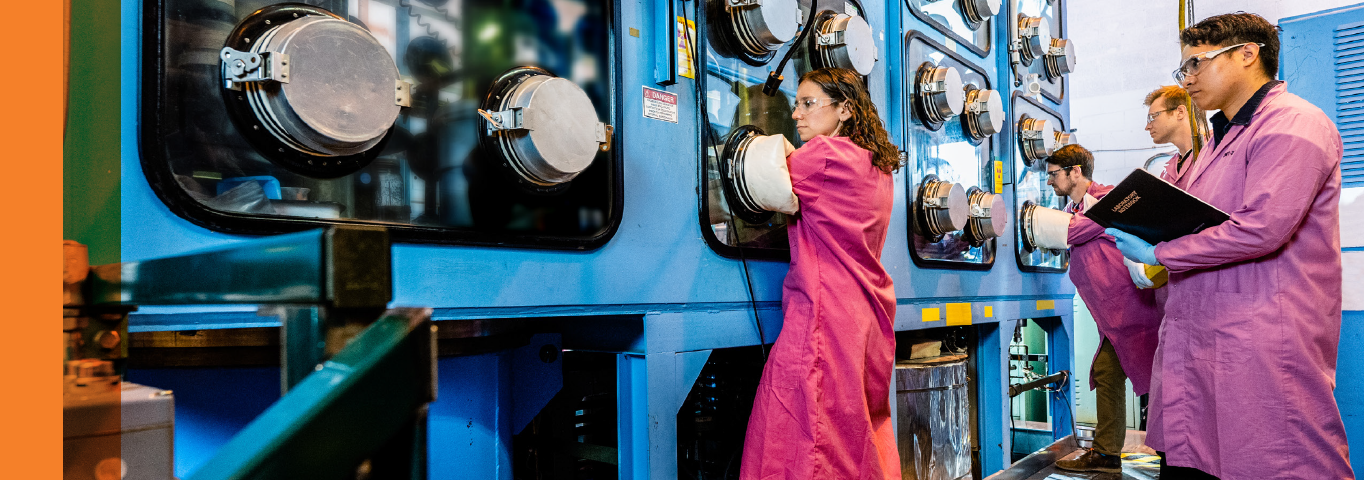
Oak Ridge National Laboratory stands at the forefront of nuclear innovation, representing expertise and capabilities that shape the design, safety, and operation of current and next-generation nuclear reactors. From foundational nuclear data to advanced manufacturing, ORNL’s integrated capabilities aim to solve complex challenges and usher in the future of nuclear.
Modeling And Simulation For Design And Operations
ORNL is a global leader in nuclear modeling and simulation, leveraging advanced computational science. For decades, ORNL has overseen development of advanced software including SCALE, a comprehensive modeling and simulation suite for nuclear safety analysis and design, and the Virtual Environment for Reactor Applications (VERA), providing high-resolution integrated physics simulations with advanced uncertainty quantification capabilities for light water reactors.
Our Impact
AI for Nuclear
Established a methodology for validating the use of AI agents for model development in confirmatory analysis workflows for current and
future reactors.
Qualification Benchmarking
Completed the advanced reactor benchmark library supporting standardization of simulation qualification for application to next-generation reactor design and licensing.
Nuclear Criticality Safety
ORNL develops Nuclear Criticality Safety mitigation methods and tools to ensure the safe handling, processing, storage, and transportation of fissionable materials outside reactor systems. ORNL also provides training and guidance to NNSA partners, in addition to developing and performing vital experiments.
Our Impact
Fuel Benchmarking
Leading benchmark experiment programs supporting the use of HALEU and TRISO fuels, supporting DOE, the Nuclear Regulatory
Commission, and industry.
Isotope Evaluations
Nuclear data for more than 50 isotopes have been measured and more than 200 isotope evaluations have been contributed to the Evaluated Nuclear Data File in support of criticality safety and reactor physics programs.
Nuclear Safeguards and Physical Security
ORNL supports the global nuclear community with security R&D focused on preventing theft, sabotage, and misuse of nuclear materials and facilities worldwide. ORNL also provides technical analysis and conceptual development of safeguards and approaches for material control and accounting programs, supporting licensing and authorization processes for advanced nuclear reactor and fuel cycle facility developers.
Our Impact
Holdup Measurements
Developed technology to improve accuracy of holdup quantification in processing facilities, enhancing material accountancy capabilities, and providing alternative sources for verification of unirradiated uranium-bearing items.
Risk and Reliability For Optimized Operations
ORNL assists the nuclear industry in developing new methods and assessing the complexities of risk in physical security, reactor safety, nonproliferation, grid and energy generation, system reliability, and maintenance cycle optimization. The integration of these methodologies with best estimate analyses can optimize safety features, as well as operations and maintenance strategies to increase reliability and cost-effective operations.
Our Impact
Digital Twins
Developed a risk-informed digital twin designed to enhance operational decision-making for the GE Vernova Hitachi BWRX-300 SMR
design.
Advanced Materials, Manufacturing, And Construction
ORNL drives the development of advanced materials and manufacturing methodologies crucial to the American nuclear supply chain. Multidisciplinary teams are working to demonstrate these methodologies through investigations of next-generation materials, simulations, data analytics, and artificial intelligence. Combined, ORNL’s experience and facilities are a foundation for revolutionizing complex facility deployments lowering production costs, and improving U.S.economic competitiveness.
Our Impact
Rapid Response
Delivered printed concrete forms for construction of Kairos Power’s Hermes-I test reactor.
Irradiation of 3D Prints
Demonstrated printed components in irradiations in test reactors and commercial nuclear power plants