Making Nuclear Construction Faster and More Affordable
The Advanced Construction Technology Initiative (ACTI) demonstrates construction technologies and approaches that could significantly reduce cost, improve quality, and lower schedule risk for new nuclear reactor projects.
Two strategies are central to this work: enabling more construction activities to proceed in parallel and shifting work from the construction site to the fabrication shop. On-site work is inherently harder to control and inspect than shop-based fabrication, so reducing it makes construction outcomes more reliable and deployment more economical.
ACTI helps close the gap between reactor R&D and commercial deployment. Construction-related costs and risks are among the most significant barriers to commercialization, and ACTI addresses them directly.
ACTI Project Partnership
NRIC is collaborating with Purdue University’s Applied Research Institute (PARI), the Electric Power Research Institute (EPRI) and the Nuclear Energy Institute (NEI) to demonstrate construction technologies that could significantly reduce the cost and risk of new nuclear construction projects.
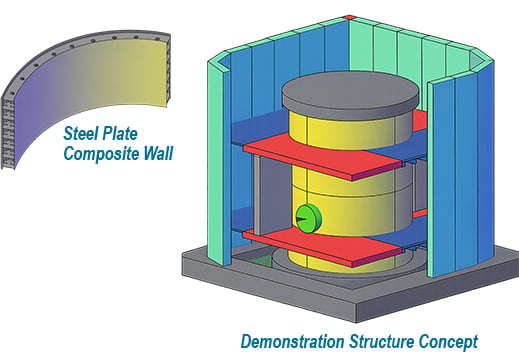
The project will construct a scaled steel-plate composite containment vessel and reactor building, generating real-world data on constructability, quality, and performance to inform future small modular reactor deployment. PARI will support NRIC through every phase of the effort: design, procurement, fabrication, field erection, concrete placement, structural integrity testing, and eventual deconstruction of the structure.
EPRI will demonstrate robotic welding techniques and non-destruction evaluation techniques as well as provide subject matter expertise on digital twin technology.
NEI will contribute quality assurance subject matter expertise and help ensure the project’s findings reach utilities, vendors, and other stakeholders preparing for advanced reactor deployment.
Work will take place at Purdue’s Robert L. and Terry L. Bowen Laboratory, one of the most advanced structural testing facilities of its kind.
Isometric 3D diagram of a cylindrical steel-plate composite containment vessel inside a surrounding reactor building, with labeled wall, slab, roof, and hatch dimensions.
Partners
Why It Matters
This will be the industry’s first full-scale-informing SCCV demonstration, with benefits that reach well beyond the site:
Confidence for regulators & the public
Regulators, vendors, and the public gain assurance about cost, schedule, and structural performance from a physical test.
Lower risk for future builds
The project tests several materials, module layouts, and joining methods, with data feeding a digital twin.
A stronger nuclear workforce
Working with trade organizations, a workforce program trains and expands the U.S. nuclear construction workforce while the build is underway.