
PNNL Fact sheet
Mission
PNNL applies its multidisciplinary expertise in chemistry, materials science, data analytics, and engineering to solve the nation’s most pressing nuclear energy challenges—enabling reliable energy, reducing waste, and supporting the safe and secure use of nuclear technologies worldwide.
Nuclear Energy Mission Areas
Reactor Operations
- Post-irradiation examination (PIE) of highburnup fuel, cladding, and components
- Stress corrosion cracking
- Cable aging and nondestructive evaluation (NDE)
- High-dose radiation exposure testing
- Reactor materials performance testing, characterization, and multiscale modeling
Nuclear Energy for Energy Resilience & Reliability
- Energy-economic modeling
- Grid integration
- Nuclear-hydrogen integration and
industrial heat applications - Analysis of nuclear energy’s contribution to bulk power system reliability
Nuclear Safeguards & Nonproliferation
- Safeguards technology, verification
methods, and monitoring for national
and international deployment - Radiation detection and measurement science
Integrated Waste Management & Disposal
- Used nuclear fuel (UNF) storage, transportation, and disposal system analysis
- Waste form development (glass, grout, ceramic, cermet, and iodine capture media)
- Geologic disposal and long-term performance assessment
- Probabilistic risk assessment (PRA) for storage and transportation
Advanced Reactors & Fuel Cycles
- Advanced materials and fuel development for extreme environments
- Molten salt and coolant chemistry characterization and corrosion science
- Tri-structural isotropic (TRISO) and metallic fuel performance modeling
- Aqueous and nonaqueous separations
chemistry, actinide and fission product science, and proliferationresistant
fuel cycle technologies - Durable materials for the long-term-stable immobilization of high-level nuclear waste
- Radiation effects on structural and fuel materials
- Cybersecurity and cyber-physical security
Core Scientific & Engineering Capabilities
Nuclear Materials & Chemistry
- Irradiated materials characterization
- Actinide chemistry and separations
- Radiochemistry and radiation
measurement science - Integrated off-gas systems designs
- Advanced microscopy and atomistic characterization
Applied Materials & Manufacturing
- Solid phase processing (ShAPE™, cold spray, and friction stir welding)
- Advanced tube, component, and alloy development
- Physics-guided and AI-enhanced flaw characterization
Nondestructive Evaluation & Structural Integrity
- NDE technique development and modeling
- Ultrasonics, eddy current, phased-array,
and radiographic evaluation - Structural analysis of fuel storage/transportation casks
Reactor Modeling, Engineering, & Safety Analysis
- Core design, shielding analysis, and fuel performance modeling
- Multiphysics, computational fluid
dynamics, and thermal-hydraulics modeling with scaled test platforms - Severe accident and safety analysis
- Advanced PRA and risk-informed decision tools
- High-performance computing for large-scale nuclear applications
Digital & Sensor Technologies
- Online monitoring, advanced sensors, and instrumentation
- AI and machine learning for plant operations
Core Scientific & Engineering Capabilities
Nuclear Materials & Chemistry
- Irradiated materials characterization
- Actinide chemistry and separations
- Radiochemistry and radiation
measurement science - Integrated off-gas systems designs
- Advanced microscopy and atomistic characterization
Applied Materials & Manufacturing
- Solid phase processing (ShAPE™, cold spray, and friction stir welding)
- Advanced tube, component, and alloy development
- Physics-guided and AI-enhanced flaw characterization
Nondestructive Evaluation & Structural Integrity
- NDE technique development and modeling
- Ultrasonics, eddy current, phased-array,
and radiographic evaluation - Structural analysis of fuel storage/transportation casks
Reactor Modeling, Engineering, & Safety Analysis
- Core design, shielding analysis, and fuel performance modeling
- Multiphysics, computational fluid
dynamics, and thermal-hydraulics modeling with scaled test platforms - Severe accident and safety analysis
- Advanced PRA and risk-informed decision tools
- High-performance computing for large-scale nuclear applications
Digital & Sensor Technologies
- Online monitoring, advanced sensors, and instrumentation
- AI and machine learning for plant operations
PNNL's Nuclear Research Corridor
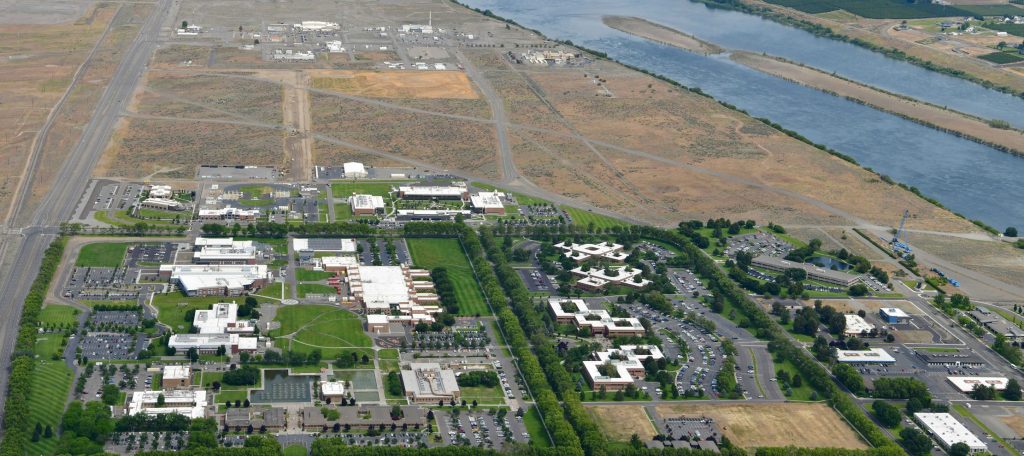
Located at the PNNL-Richland campus in Washington, this suite of modern, interconnected Hazard Category II and radiological/non-radiological facilities enables research ranging in scale from atomistic to pilot-scale.
Radiochemical Processing Laboratory (RPL)
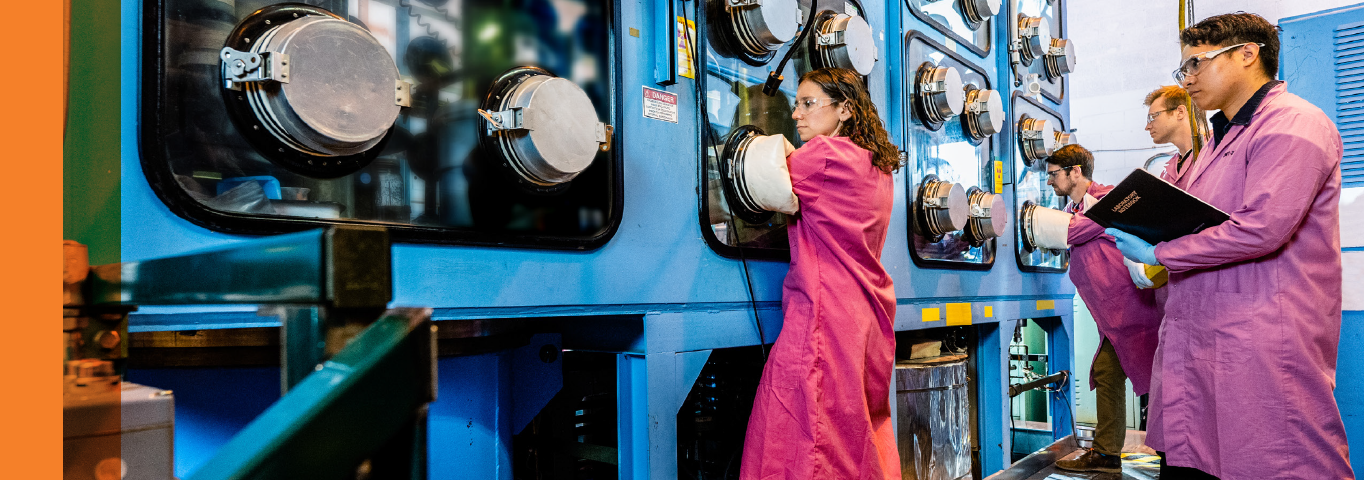
A nuclear science user facility, is a Hazard Category II nonreactor research nuclear facility that enables scientists to work safely with significant quantities of radioactive materials, supporting research in nuclear chemistry, waste processing, and radioisotope production. It houses specialized shielded hot cells, glove boxes, and laboratories that support national security, environmental cleanup, and nuclear energy missions. RPL is capable of accepting and managing full-length fuel rods.
Materials Science and Technology Laboratory
A science user facility, enables the synthesis, characterization, and testing of advanced materials for energy, manufacturing, and national security applications. Its capabilities support innovations in areas such as energy storage, lightweight materials, and high-performance components for extreme environments.
Radiological Exposures and Metrology Laboratory
Provides precise radiation measurement, dosimetry, and calibration services to ensure accurate assessment of radiological exposures. It supports worker safety, regulatory compliance, and the development of advanced radiation detection and measurement standards.
Advanced Engineering Laboratory
Provides space and equipment for designing, prototyping, and testing engineered systems and instrumentation. It supports the development of sensors, electronics, and integrated devices that address challenges in energy, national security, and environmental science.
Nondestructive Evaluation Laboratory
Develops and applies advanced techniques to inspect materials and components without causing damage, ensuring structural integrity and reliability. Its work supports nuclear energy systems, infrastructure assessment, and quality assurance for critical engineered components.
Waste Form Development Laboratory
Focuses on creating and evaluating durable materials such as glass and ceramics for immobilizing radioactive and hazardous wastes. Research here advances safe, long-term disposal solutions and supports environmental cleanup missions like the Hanford Site tank waste vitrification effort.
Shallow Underground Laboratory
Contains the specialized Ultra-Low Background and Radiation Detection Laboratory. This provides shielded, cleanroom environments, which minimize background radiation to enable the detection of extremely faint radioactive signals. It supports research in nuclear nonproliferation, fundamental physics, and the development of highly sensitive detection technologies.
Environmental Molecular Sciences Laboratory (EMSL)
Is a DOE Office of Science user facility with advanced characterization and computational capabilities. EMSL provides researchers with molecular-level insights into the materials and chemical processes underpinning the nuclear fuel cycle, from fuel fabrication to waste management. These capabilities support advanced reactor deployment by enabling evaluation of fuel performance, material degradation, and corrosion under realistic operating conditions.
Marine and Coastal Research Laboratory
Located at PNNL Sequim near the Strait of Juan de Fuca in Puget Sound, is DOE’s only marine research facility. PNNL- Sequim offers direct access to coastal waters where systems and components that are expected to operate in the maritime environment can be tested to understand and mitigate risks and challenges.
Key Experimental Equipment
PNNL’s facilities house state-of-the-art experimental equipment to support nuclear energy efforts, including sustaining the existing fleet, developing advanced reactors, and exploring innovations such as fusion energy and UNF recycling.
Hot Cells and Shielded Glove Boxes: Heavily shielded, remote-operated enclosures that allow researchers to safely work with highly radioactive materials, including spent fuel segments and waste samples.
Ultra-Low-Background Radiation Detectors: High-purity germanium (HPGe) detectors and other highly sensitive systems, primarily housed in the Shallow Underground Laboratory, for detecting minute quantities of radioactive material.
Advanced Electron Microscopes: A suite of transmission electron microscopy (TEM) and scanning electron microscopy (SEM) equipment for imaging materials at the atomic scale. Many are equipped for in situ experiments (e.g., heating and straining) on radioactive samples.
X-Ray Diffraction (XRD) and Spectroscopy Devices: Instruments used to determine the crystal structure and chemical composition of nuclear materials and waste forms.
Atom Probe: Atom probe tomography (APT) is a technique that provides 3D visualization of a material’s elemental composition at the atomic scale, used to study segregation and clustering in irradiated alloys.
Why PNNL?
60+ YEARS OF NUCLEAR SCIENCE LEADERSHIP
A UNIQUE COMBINATION OF CHEMISTRY, MATERIALS, COMPUTING, AND SECURITY EXPERTISE
SPECIALIZED RADIOLOGICAL FACILITIES AND INSTRUMENTATION
A TRUSTED PARTNER FOR GOVERNMENT, INDUSTRY, AND ACADEMIA
Nuclear Energy at PNNL
Explore PNNL’s work advancing nuclear power for a reliable, safe, and secure energy future.