DOME Demonstration

Westinghouse Electric Company is currently developing the eVinci™ Microreactor, a next-generation, micro-modular reactor for decentralized remote applications. The eVinci microreactor’s innovative design combines new technologies with 60+ years of commercial nuclear design and engineering, creating a cost-competitive and resilient source of power with superior reliability and minimal maintenance. Its small size allows for transportability and rapid, on-site deployment in contrast to plants requiring large amounts of construction. The eVinci microreactor can produce 5MWe with a 15MWth core design. The reactor core is designed to run for eight or more full-power years before refueling. Through its eVinci microreactor, Westinghouse is making clean and constant energy possible – anywhere.
In 2023 the National Reactor Innovation Center (NRIC) issued an RFP for the Front-End Engineering and Experiment Design (FEEED) process for testing in NRIC’s Demonstration of Microreactor Experiments (DOME) at Idaho National Laboratory (INL), under which, developers proposed the scope of work to complete the FEEED process for their advanced reactor for testing in the NRIC DOME. Westinghouse submitted a proposal for the testing of a 1/5 scaled eVinci reactor which will produce 1MWe with a 3 MWth core design. Westinghouse was selected by NRIC and the Department of Energy (DOE) to complete the FEEED process in October of 2023. Westinghouse, in collaboration with NRIC, successfully completed the FEEED process in August 2024. Following the completion of the FEEED process, Westinghouse was selected and awarded a contract for Detailed Engineering and Experiment Planning (DEEP), which is the next phase in the process for testing advanced reactors in DOME. This work is expected to be completed throughout 2025.

Radiant is currently developing the Kaleidos Microreactor, a portable reactor with 1MW electric output intended to replace diesel generators in both remote areas and temporary applications, and to provide resilient backup power for hospitals, datacenters, and military installations. Requiring zero on site water use by leveraging fans for air cooling, Kaleidos can operate anywhere. High speed turbomachinery provides load-following capabilities by operating efficiently from 30% to 100% power, enabling resilient microgrids. While generating electricity, Kaleidos also can provide 1.9 MW of thermal power for facility heating or water desalination. Kaleidos will be assembled, fueled, and tested in the factory for streamlined deployment. The unit is delivered via truck on highway routes, or delivery can be expedited by aircraft. After 5 years of operation the entire container can be shipped back for refueling at the factory. Kaleidos can be refueled a total of 3 times for a 20-year product lifetime.
In 2023 the National Reactor Innovation Center (NRIC) issued an RFP for the Front-End Engineering and Experiment Design (FEEED) process for testing in NRIC’s Demonstration of Microreactor Experiments (DOME) at Idaho National Laboratory (INL), under which, developers proposed the scope of work to complete the FEEED process for their advanced reactor for testing in the NRIC DOME. Radiant submitted a proposal for the testing of Kaleidos and was selected by NRIC and the Department of Energy (DOE) to complete the FEEED process in October of 2023. Radiant, in collaboration with NRIC, successfully completed the FEEED process in November 2024. Following the completion of the FEEED process, Radiant was selected and awarded a contract for Detailed Engineering and Experiment Planning (DEEP), which is the next phase in the process for testing advanced reactors in DOME. This work is expected to be completed throughout 2025.
In 2023 the National Reactor Innovation Center (NRIC) issued an RFP for the Front-End Engineering and Experiment Design (FEEED) process for testing in NRIC’s Demonstration of Microreactor Experiments (DOME) at Idaho National Laboratory (INL), under which, developers proposed the scope of work to complete the FEEED process for their advanced reactor for testing in the NRIC DOME. Westinghouse submitted a proposal for the testing of a 1/5 scaled eVinci reactor which will produce 1MWe with a 3 MWth core design. Westinghouse was selected by NRIC and the Department of Energy (DOE) to complete the FEEED process in October of 2023. Westinghouse, in collaboration with NRIC, successfully completed the FEEED process in August 2024. Following the completion of the FEEED process, Westinghouse was selected and awarded a contract for Detailed Engineering and Experiment Planning (DEEP), which is the next phase in the process for testing advanced reactors in DOME. This work is expected to be completed throughout 2025.

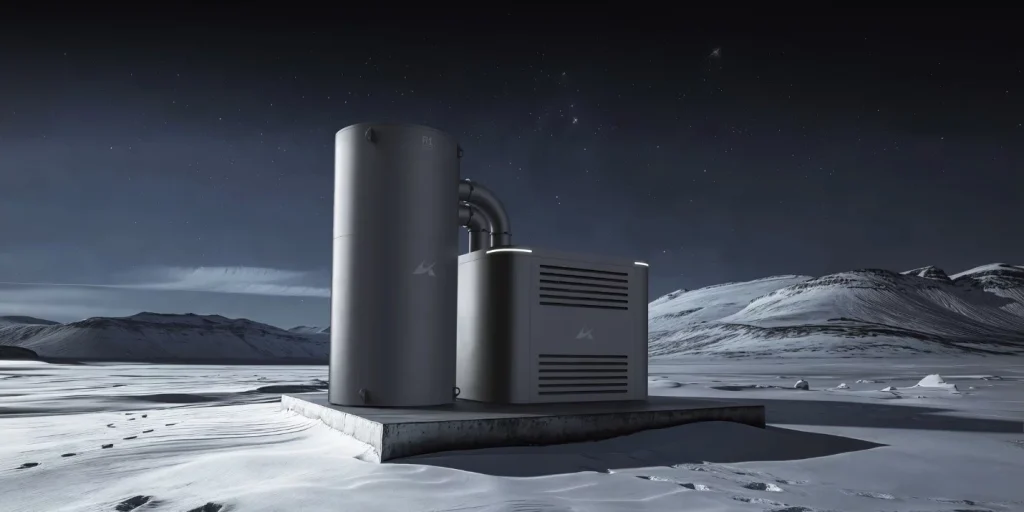
Antares is currently developing the Antares R1 Microreactor, a rapidly deployable microreactor designed for critical infrastructure resilience. R1 is being designed for austere and remote terrestrial applications and adaptable to space-based power needs. The Antares R1 supplies continuous energy with no sustaining supply chain for three years and includes automated controls, power management, and distribution with no specialized workforce.
In October of 2024, Antares began self-funding the Front-End Engineering and Experiment Design (FEEED) process for testing of the Antares R1 in NRIC’s Demonstration of Microreactor Experiments (DOME) at Idaho National Laboratory (INL). Antares, in collaboration with NRIC, will work to complete the FEEED process
throughout 2025.