
Advanced Construction Technology Initiative
Steel-Plate Composite Demonstration

Making Nuclear Construction Faster and More Affordable
The Advanced Construction Technology Initiative (ACTI) demonstrates construction technologies and approaches that could significantly reduce cost, improve quality, and lower schedule risk for new nuclear reactor projects.
Two strategies are central to this work: enabling more construction activities to proceed in parallel and shifting work from the construction site to the fabrication shop. On-site work is inherently harder to control and inspect than shop-based fabrication, so reducing it makes construction outcomes more reliable and deployment more economical.
ACTI helps close the gap between reactor R&D and commercial deployment. Construction-related costs and risks are among the most significant barriers to commercialization, and ACTI addresses them directly.
ACTI Project Partnership
NRIC is collaborating with Purdue University’s Applied Research Institute (PARI), the Electric Power Research Institute (EPRI) and the Nuclear Energy Institute (NEI) to demonstrate construction technologies that could significantly reduce the cost and risk of new nuclear construction projects.
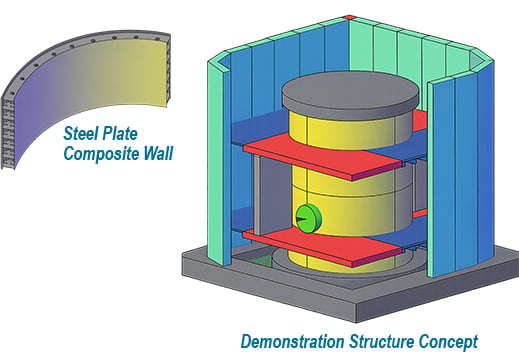
The project will construct a scaled steel-plate composite containment vessel and reactor building, generating real-world data on constructability, quality, and performance to inform future small modular reactor deployment. PARI will support NRIC through every phase of the effort: design, procurement, fabrication, field erection, concrete placement, structural integrity testing, and eventual deconstruction of the structure.
EPRI will demonstrate robotic welding techniques and non-destruction evaluation techniques as well as provide subject matter expertise on digital twin technology.
NEI will contribute quality assurance subject matter expertise and help ensure the project’s findings reach utilities, vendors, and other stakeholders preparing for advanced reactor deployment.
Work will take place at Purdue’s Robert L. and Terry L. Bowen Laboratory, one of the most advanced structural testing facilities of its kind.


Why It Matters
This will be the industry’s first full-scale-informing SCCV demonstration, with benefits that reach well beyond the site:
Confidence for regulators & the public
Regulators, vendors, and the public gain assurance about cost, schedule, and structural performance from a physical test.
Lower risk for future builds
The project tests several materials, module layouts, and joining methods, with data feeding a digital twin.
A stronger nuclear workforce
Working with trade organizations, a workforce program trains and expands the U.S. nuclear construction workforce while the build is underway.
Frequently Asked Questions
What will be built at Purdue? Its size, cost and schedule?
The Idaho National Laboratory’s National Reactor Innovation Center (NRIC)’s Advanced Construction Technology Initiative (ACTI), in partnership with Purdue Applied Research Institute (PARI), the Nuclear Energy Institute (NEI), and Electric Power Research Institute (EPRI), will construct a 1/3 scale Steel Plate Composite reactor building at the Purdue Center for the Aging Infrastructure (CAI). The proposed project is to conduct a construction mockup, integrity evaluation, and deconstruction demonstration of a scaled steel-plate composite containment vessel (SCCV) and surrounding safety-related reactor building (RB). The SCCV and RB structures will be generic (non-proprietary) and representative of typical small modular reactors (SMRs) applications being considered for deployment in the U.S. This project will be executed over a 24-month period, with project kickoff recently announced.
Who will fabricate and erect it?
The project will include participation and support from all major stakeholders in the SMR deployment industry including reactor vendors, engineering-procurement-construction (EPC) firms, steel producers and resellers, steel fabricators (both with NQA and non-NQA), erectors, concrete producers, constructors, quality assurance/quality control (QA/QC) inspectors, and regulators. This will enable communication, cooperation, and coordination among these industry stakeholders in a technology agnostic project setting.
The specific vendors for steel fabrication and erection will be selected using a bidding process and will include both nuclear steel fabricators and non-nuclear or commercial steel fabricators to broaden the supply chain. The project will be managed by NRIC and PARI will be the primary executor of fabrication and construction.
What construction techniques will be tested?
The focus will be on steel-plate composite (SC) construction as applied to safety-related nuclear construction and containment vessels. This construction method has the potential to cut the construction schedule at the site by up to 50% by eliminating schedule critical and labor-intensive processes like assembly of rebar cages, assembly and removal of formwork. The steel modules are manufactured in the shop and transported to the site, assembled, erected, and then filled with concrete.
Advanced manufacturing methods, robotic/automated welding methods, SI-assisted welding techniques will be tested. Non-destructive evaluation and inspection methods including vision-based techniques will be tested.
The concrete will be high flow or self-consolidating concrete which further eliminates the need for vibration during placement and reduces site labor.
What challenges/barriers in new nuclear construction commercialization will this get into?
Some of the biggest challenges/barriers are related to construction cost certainty, schedule reliability, and optimizing quality requirements. Additional challenges include incorporating and validating new and innovative construction techniques, including robotic/automated and SI-driven welding. The need for incorporation of the latest in digital engineering, SI-based tools, and digital twins to monitor construction quality and addressing imperfections/flaws as they arise. Finally, one the biggest challenges/barriers is an experienced, qualified, and certified construction workforce and associated supply chain.
The overall objectives of the project are to:
- Generate realistic construction cost, schedule, and quality data to support future full-scale SMR deployment
- Demonstrate and validate optimized nuclear quality assurance requirements that reduce costs and schedule burden without sacrificing reliability
- Resolve open constructability and design questions (e.g., connections, welding, penetrations) through a physical mock-up
- Demonstrate advanced manufacturing methods, including robotic and SI-driven welding and digital twin technologies for as-built verification
Develop pathways for a trained, experienced nuclear construction workforce and establish a pipeline for future SMR construction labor.
Is this focused on large plants, SMRs or both?
This project will be focused on SMR construction; however the project’s design allows for lessons learned to be applicable across a broader range of nuclear projects and the data developed and lessons learned will support the entire nuclear industry.
What new areas will be demonstrated or explored that were not done under prior initiatives?
A new, innovative steel-plate composite containment vessel (SCCV), which combines steel and concrete construction to overcome the cost and schedule drawbacks of traditional steel or reinforced concrete containments will be demonstrated by this project, which has not been done before.
While steel concrete composites are getting more interest from industry, for example two SMR vendors have submitted designs to the NRC for review, regulators and industry reviewers consistently express the desire to see an SCCV built and demonstrated at scale, addressing concerns about constructability, inspectability, and structural performance. This project addresses that gap by a scaled construction mockup, integrity test, and deconstruction demonstration of a generic SCCV and associated reactor building.
Development and evaluation of optimized nuclear quality assurance / quality control requirements for containment vessels and safety-related nuclear construction will be demonstrated by this project.
How will practices in other industries benefit nuclear construction going forward?
The ACTI program is continually exploring construction technologies utilized by other industries to understand how the approaches can be leveraged in nuclear construction to reduce costs, accelerate schedules, and enhance the quality of nuclear construction. This project is one example where modern construction approaches are being brought into nuclear construction for the benefit of the entire industry.
How will workforce practices be studied?
Cost, schedule, and quality information will be gathered during this project to understand construction performance to help inform the industry of actual numbers on a project of this type utilizing this technology.
Who funds this program and how much will this get? What is time frame for program and funding?
This program is primarily funded by the Department of Energy’s Office of Nuclear Energy, with DOE providing up to approximately $27 million. The project schedule is 24 months.