LOTUS
Laboratory for Operation and Testing in the United States
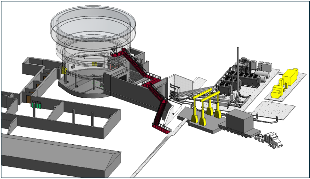
The National Reactor Innovation Center (NRIC) is designing and constructing the Laboratory for Operations and Testing in the United States (LOTUS) test bed to accelerate the development of advanced nuclear energy technologies.
LOTUS will host experimental microreactors up to 20 megawatts thermal that require an enhanced security posture, providing a controlled environment for developers to test nuclear systems going critical for the first time.
LOTUS Facility Capabilities
LOTUS is designed to accommodate a range of advanced small modular reactor and microreactor experiments within a controlled test environment. Facility features support reactor installation, operation and material handling, while providing access to infrastructure and technical resources at INL’s Materials and Fuels Complex.
Designed to Support Experimental Reactor Testing
LOTUS combines facility infrastructure, test cell capabilities and material-handling resources to accommodate a range of experimental reactor systems.
Reactor
experiments
Supports experimental reactor systems and a range of advanced reactor designs.
Heat
removal
Passive decay heat dissipation capability to support experiments in the experiment area.
Installation & material handling
Facility access and handling capabilities support movement and installation of experiment equipment.
Controlled test environment
The test bed provides dedicated space for fueled advanced reactor experiments.
Fuel
flexibility
Supports experiments using a diverse range of fuel compositions and security requirements.
Facility Operating Parameters
| Parameter | Value |
|---|---|
| Fuel Capability | Diverse fuel compositions, from molten salts to metal fuels, including fuel forms requiring enhanced security postures |
| Decay Heat Removal (Passive) | 40 kWth at shutdown, decreasing to 4 kWth after 3 days bounding condition |
| In-Cell Equipment Power | Normal: 480VAC, two 400A 3-phase panels plus one 200A 208VAC panel; Standby: additional 400A 480VAC and 200A 208VAC panels |
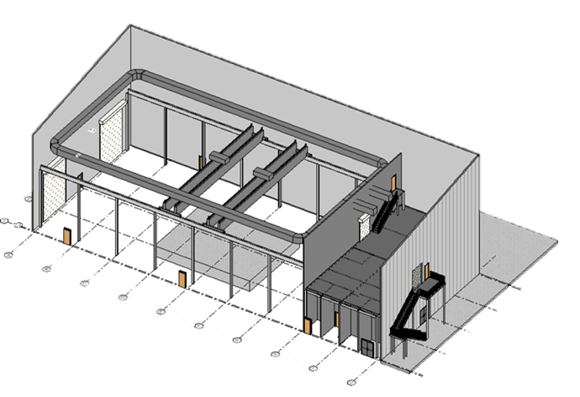
| Experiment Area | Open, high-bay space; 5,718 sq ft; negative-pressure radiological buffer area |
| Experiment Area Geometry | 28 ft minimum hook-to-floor clearance; below-grade experiment pit (30 ft wide × 40 ft long × 25 ft deep) |
| Equipment Access | Motorized overhead coiling door, 20 ft wide × 20 ft tall minimum clear opening |
| Overhead Crane Capacity | 45-ton bridge crane with 5-ton auxiliary hoist; 53 ft total hook travel to bottom of pit |
LOTUS Project Progress
Follow key milestones in the design, construction and development of the LOTUS test bed.